
guide
HESI A2 Biology study guide
The seventeen ideas that organize biology: the characteristics of life, cell structure and organelles, transport across the membrane, respiration and photosynthesis, DNA and RNA, replication and protein synthesis, mitosis and meiosis, Mendelian genetics with a worked Punnett square, how living things are classified, how an experiment is set up, the Gram stain, the chain of infection, the immune response, and the properties of water.
What this topic actually asks of you
Biology on this exam is the study of the cell and of what cells pass on. The vocabulary is smaller than anatomy's, but it is more abstract: the work is to say what a structure does, which process moves a substance, or what a cross produces — each one answered by a mechanism, not by a list.
Elsevier lists biology among the areas the HESI A2 covers. The publisher releases no national content specification — no item count, no clock, no cut score — so nothing on this page mirrors an official weighting, and nothing here claims to. The scope is a teaching scope: the cell first, then the processes that keep it running, then inheritance.
The genetics definitions on this page follow the National Human Genome Research Institute's Talking Glossary of Genomic and Genetic Terms, and the cell and organ descriptions follow the US National Cancer Institute's SEER training modules on the cell, with MedlinePlus for the process-level descriptions. The infection-control section — the chain of infection and the five modes of transmission — follows the US Centers for Disease Control and Prevention's Principles of Epidemiology in Public Health Practice (third edition, lesson 1, section 10, the chain of infection), and the water properties follow the US Geological Survey's Water Science School pages on cohesion and adhesion and on specific heat. These are US federal government publications, which are not subject to copyright in the United States.
The seventeen ideas this page teaches
These are the ideas a question is built from, and they are the headings this page uses.
- The characteristics of life — what makes something alive, and the cell theory that follows.
- Cell structure — the plasma membrane, the cytoplasm and the organelles, animal and plant.
- Movement across the membrane — diffusion, osmosis, facilitated diffusion, active transport, endocytosis and exocytosis.
- Tonicity — what a red cell does in a hypotonic, isotonic and hypertonic solution.
- Cellular respiration — glycolysis, the Krebs cycle and the electron transport chain.
- Photosynthesis — the light reactions and the Calvin cycle, and how they compare with respiration.
- DNA and RNA — nucleotides, base pairing, and the double helix.
- Replication, transcription and translation — the central dogma, step by step.
- Mitosis — the phases, and what a daughter cell receives.
- Meiosis — two divisions, four haploid cells, and where the variation comes from.
- Mendelian genetics — alleles, Punnett squares, genotype and phenotype ratios.
- Classification and microorganisms — how living things are grouped, and what is not a cell.
- The scientific method — hypothesis, variables, control group, and what a theory is.
- Bacteria and the Gram stain — the prokaryote cell, the four reagents, and what pink and purple mean.
- The chain of infection — the six links, and the five routes of transmission.
- The immune response — innate and adaptive immunity, B cells and T cells, antigen and antibody.
- Water — cohesion, adhesion, specific heat and heat of vaporization.
The characteristics of life, and the cell theory
A living thing is recognized by what it does, not by what it is made of. The standard list is organization (it has parts arranged in a way that works), metabolism (it takes in energy and uses it), responsiveness (it reacts to a stimulus), movement, growth, development and reproduction. A virus fails several of those tests, which is why it is described as a biological agent rather than as a living cell.
The cell theory is the frame under the rest of the topic: all living things are made of one or more cells, the cell is the basic unit of structure and function in living things, and new cells come from existing cells by division. That third statement is why mitosis and meiosis are not separate topics but the mechanism behind the first two.
| Question | What the answer is |
|---|---|
| What are the characteristics shared by living things? | organization, metabolism, responsiveness, movement, growth, development and reproduction |
| What does the cell theory state? | all living things are made of cells, the cell is the basic unit of structure and function, and new cells come from existing cells |
| What is the difference between a prokaryote and a eukaryote? | a prokaryote has no nucleus and no membrane-bound organelles; a eukaryote has both |
| Which structures do prokaryotes and eukaryotes both have? | a plasma membrane, cytoplasm, ribosomes and DNA |
| Which two domains are prokaryotic? | Bacteria and Archaea |
| What is the difference between growth and development? | growth is an increase in size or cell number; development is the change in form and function that comes with it |
Cell structure: the membrane, the cytoplasm and the organelles
Every cell is bounded by a plasma membrane and filled with cytoplasm, which is the cytosol plus the organelles suspended in it. The membrane is a phospholipid bilayer: each phospholipid has a water-loving head facing outward and a water-fearing tail facing inward, so the two layers of tails form a barrier that water and charged particles cannot cross freely. Proteins sit in and through the layer as channels, pumps and receptors, cholesterol steadies the membrane's fluidity, and the whole arrangement is described as a fluid mosaic.
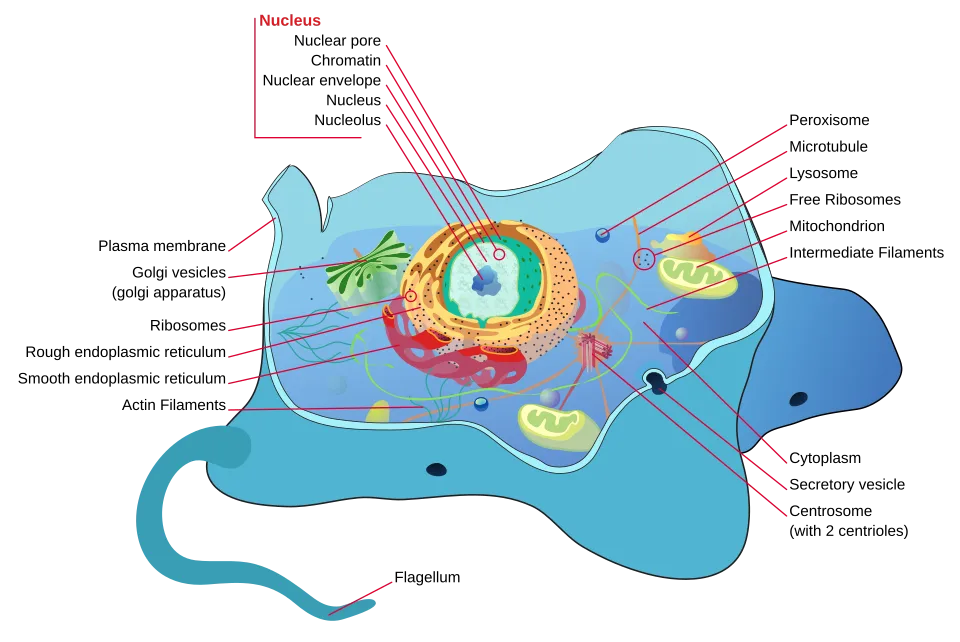
Image: Animal cell structure en.svg by Mariana Ruiz Villarreal (LadyofHats), public domain, via Wikimedia Commons.
| Question | The answer |
|---|---|
| What does the nucleus hold, and what does it do? | the cell's DNA, as chromatin, and it controls the cell's activities by directing protein synthesis |
| What is the nucleolus? | the structure inside the nucleus where ribosomal RNA is made and ribosomes are assembled |
| What do ribosomes do? | they assemble proteins from amino acids, following the message carried by mRNA |
| What does the rough endoplasmic reticulum do? | it folds and modifies proteins made on the ribosomes attached to it |
| What does the smooth endoplasmic reticulum do? | it makes lipids, detoxifies substances and stores calcium |
| What does the Golgi apparatus do? | it modifies, sorts and packages proteins into vesicles for transport |
| What does a mitochondrion do? | it produces most of the cell's ATP through cellular respiration |
| What does a lysosome contain, and what does it do? | digestive enzymes; it breaks down worn-out organelles and material taken into the cell |
| What do peroxisomes do? | they break down fatty acids and neutralize hydrogen peroxide |
| What are microtubules for? | they form the spindle that moves chromosomes, and the core of cilia and flagella |
| What are centrioles for? | they organize the spindle fibers during cell division in animal cells |
Two membranes are worth knowing by their folds. The inner mitochondrial membrane is folded into cristae, which increase the area on which the electron transport chain sits; the chloroplast's internal membranes are stacked into thylakoids, and a stack of thylakoids is a granum, sitting in the fluid called the stroma.
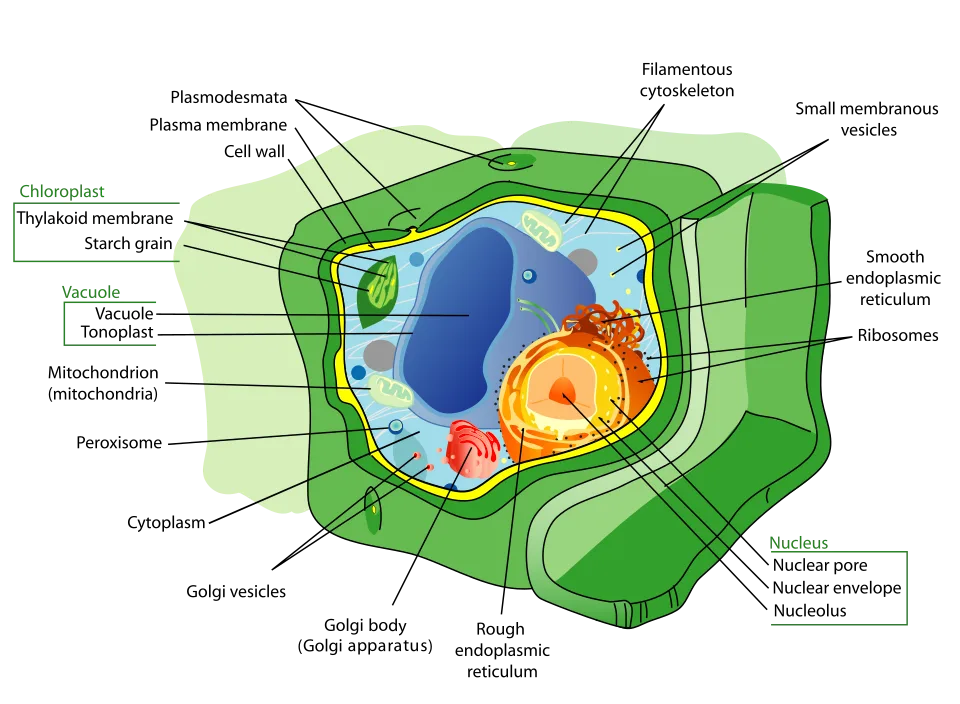
Image: Plant cell structure-en.svg by Mariana Ruiz Villarreal (LadyofHats), public domain, via Wikimedia Commons.
A plant cell is a eukaryotic cell with three additions, not a different kind of cell. It has a cell wall of cellulose outside the membrane, which gives shape and resistance to pressure; it has chloroplasts, where photosynthesis happens; and it usually has a large central vacuole, bounded by the tonoplast, which stores water and dissolved substances and provides turgor — the internal pressure that keeps a soft plant standing up.
| Question | The answer |
|---|---|
| What do chloroplasts do? | they carry out photosynthesis, using chlorophyll to capture light energy |
| What makes up a plant cell wall? | cellulose, outside the plasma membrane |
| What does the large central vacuole do in a plant cell? | it stores water and solutes and provides turgor pressure |
| Which structures does a plant cell have that an animal cell does not? | a cell wall, chloroplasts and a large central vacuole |
| Which structures does an animal cell have that most plant cells do not? | centrioles, and lysosomes as a distinct organelle |
| What do plant cells use instead of a skeleton to stay upright? | turgor pressure from the central vacuole |
Movement across the membrane
The membrane is selectively permeable, which means the question is never "can something cross?" but "by which route, and does the route need energy?". Three of the routes are passive — they run down a concentration gradient and cost the cell nothing — and the rest are active.
| Question | The answer |
|---|---|
| What is simple diffusion? | movement of a substance from higher to lower concentration directly through the membrane, with no energy and no carrier |
| Which substances cross by simple diffusion? | small, nonpolar molecules such as oxygen and carbon dioxide |
| What is facilitated diffusion? | movement down a concentration gradient through a channel or carrier protein, with no energy |
| What is osmosis? | the movement of water across a membrane toward the side with the higher solute concentration |
| What is active transport? | movement against a concentration gradient, driven by ATP |
| What does the sodium-potassium pump move, and in which direction? | three sodium ions out of the cell and two potassium ions in, against their gradients, using ATP |
| What is endocytosis? | the cell taking material in by folding its membrane around it into a vesicle |
| What is phagocytosis? | endocytosis of a solid particle, such as a bacterium, by a white blood cell |
| What is exocytosis? | the release of material from the cell when a vesicle fuses with the plasma membrane |
Osmosis has its own vocabulary, and the vocabulary is about the solution, not the cell. A hypertonic solution has more solute than the cell, so water leaves and the cell shrinks — a red cell in this state crenates. A hypotonic solution has less solute than the cell, so water enters and the cell swells and may lyse. An isotonic solution has the same solute concentration, so there is no net movement. A plant cell in a hypertonic solution loses turgor and its membrane pulls away from the wall — plasmolysis.
| Question | The answer |
|---|---|
| What happens to a red blood cell in a hypertonic solution? | water leaves the cell, and it shrinks and crenates |
| What happens to a red blood cell in a hypotonic solution? | water enters the cell, and it swells and may lyse |
| What happens to a cell in an isotonic solution? | there is no net movement of water, so the cell keeps its shape |
| What is plasmolysis? | the shrinking of a plant cell's membrane away from its wall in a hypertonic solution |
| Which way does water move in osmosis? | toward the side with the higher solute concentration |
Cellular respiration: glucose to ATP
Cellular respiration releases the energy stored in glucose and captures it as ATP. It has three stages, and each stage has a place and a yield that a question can ask for.
| Question | The answer |
|---|---|
| Where does glycolysis happen? | in the cytoplasm |
| What does glycolysis do? | it splits one glucose into two pyruvate molecules, with a net gain of two ATP and two NADH |
| Where does the Krebs (citric acid) cycle happen? | in the mitochondrial matrix |
| What does the Krebs cycle release? | carbon dioxide, and it produces ATP, NADH and FADH2 |
| Where does the electron transport chain sit? | in the inner mitochondrial membrane |
| What is the final electron acceptor in the electron transport chain? | oxygen, which combines with electrons and hydrogen to form water |
| How much ATP does one glucose yield in aerobic respiration? | about 30 to 32 ATP, depending on the cell and the shuttle used |
| What happens when oxygen is not available? | pyruvate is converted to lactate in human muscle, or to ethanol and carbon dioxide in yeast |
Two details carry the rest. First, glycolysis is the only stage that needs no oxygen — it runs in the cytoplasm, which is why a cell can still make a little ATP when oxygen runs out. Second, most of the ATP comes from the electron transport chain, not from glycolysis or the Krebs cycle directly; those stages produce the NADH and FADH2 that carry electrons to the chain.
| Question | The answer |
|---|---|
| Which stage of respiration produces the most ATP? | the electron transport chain, through oxidative phosphorylation |
| Which stages produce carbon dioxide? | the Krebs cycle, and the conversion of pyruvate before it |
| What is anaerobic respiration in human muscle? | glycolysis followed by lactic acid fermentation, which regenerates NAD+ so glycolysis can continue |
| Why does fermentation matter if it makes no ATP of its own? | it regenerates NAD+, without which glycolysis would stop |
Photosynthesis: light to sugar
Photosynthesis is respiration reversed in its inputs and outputs, and it runs in two stages named for where they happen. The light reactions take place in the thylakoid membranes: light energy is captured by chlorophyll, water is split, oxygen is released, and the energy is stored in ATP and NADPH. The Calvin cycle takes place in the stroma: carbon dioxide is fixed into an organic molecule and, using the ATP and NADPH from the light reactions, is built into glucose.
| Question | The answer |
|---|---|
| In which organelle does photosynthesis happen? | the chloroplast |
| What are the inputs of photosynthesis? | carbon dioxide, water and light energy |
| What are the outputs of photosynthesis? | glucose and oxygen |
| Where do the light reactions happen? | in the thylakoid membranes |
| Which gas is released when water is split in the light reactions? | oxygen |
| Where does the Calvin cycle happen? | in the stroma of the chloroplast |
| What does the Calvin cycle use carbon dioxide for? | fixing it into organic molecules that become glucose |
| Which two energy carriers link the light reactions to the Calvin cycle? | ATP and NADPH |
| Question | The answer |
|---|---|
| Which process stores energy, and which releases it? | photosynthesis stores energy in glucose; cellular respiration releases it |
| Which gas does each process take in? | photosynthesis takes in carbon dioxide; respiration takes in oxygen |
| Which gas does each process release? | photosynthesis releases oxygen; respiration releases carbon dioxide |
| Which organelle does each process use? | photosynthesis uses the chloroplast; aerobic respiration uses the mitochondrion |
DNA and RNA
DNA is a polymer of nucleotides, and each nucleotide has three parts: a phosphate group, a five-carbon sugar (deoxyribose) and one of four nitrogenous bases — adenine (A), thymine (T), guanine (G) and cytosine (C). The nucleotides are joined into two strands, the phosphate of one nucleotide bonding to the sugar of the next, and the two strands run in opposite directions and twist around each other into a double helix. The bases pair across the middle: A with T, and G with C. That pairing is the whole mechanism of copying and of reading.
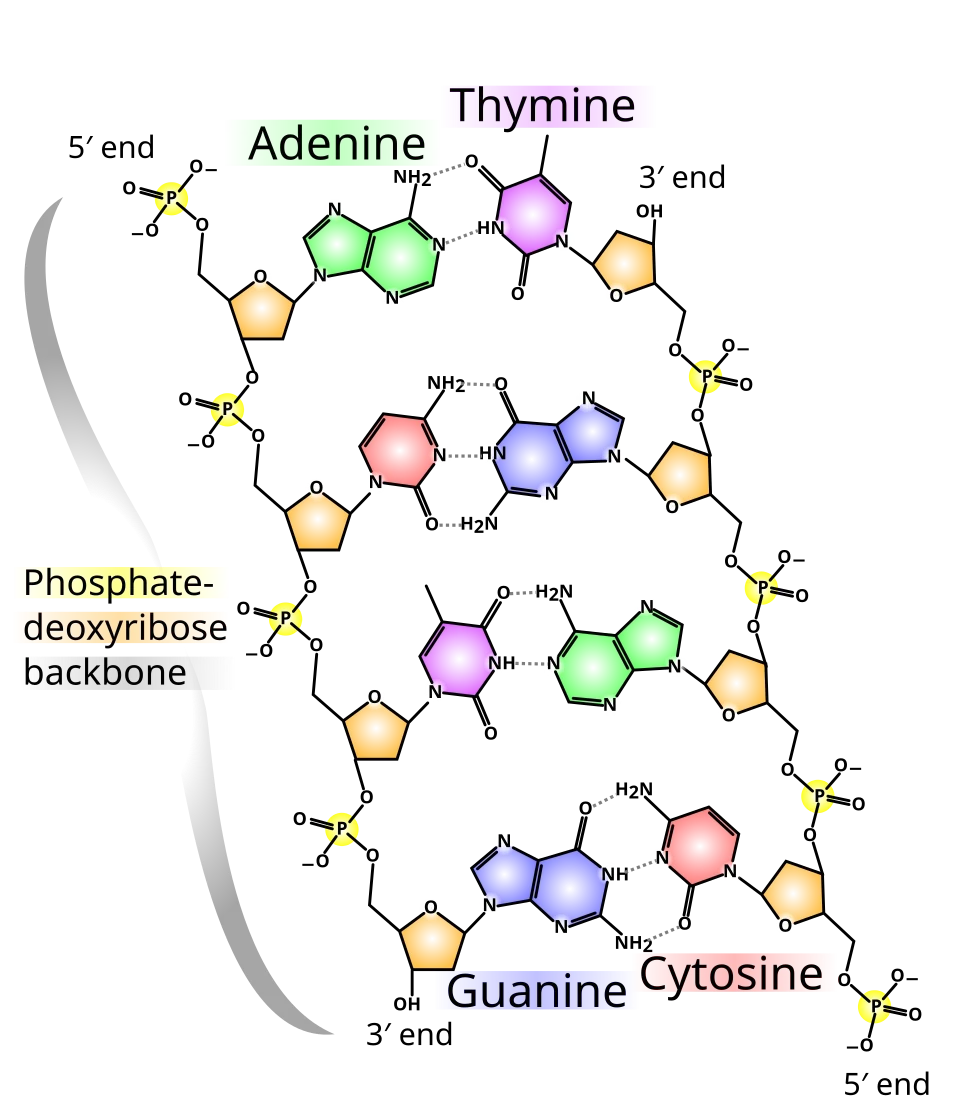
Image: DNA chemical structure.svg by Madprime, CC BY-SA 3.0, via Wikimedia Commons.
The figure shows the flat chemical structure — the sugar–phosphate backbone on the outside and the paired bases across the middle — rather than the twisted ribbon. The helix is what that flat ladder becomes when the two strands coil around a shared axis, with the paired bases on the inside.
RNA differs from DNA in three ways that questions use: its sugar is ribose rather than deoxyribose, it is single-stranded rather than double, and it carries uracil (U) in place of thymine. So an RNA strand that reads a DNA template pairs A with U, T with A, G with C and C with G.
| Question | The answer |
|---|---|
| What are the three parts of a nucleotide? | a phosphate group, a five-carbon sugar and a nitrogenous base |
| Which sugar does DNA contain? | deoxyribose |
| Which sugar does RNA contain? | ribose |
| Which base does RNA have in place of thymine? | uracil |
| Which base does adenine pair with in DNA? | thymine |
| Which base does guanine pair with? | cytosine |
| Which base does adenine pair with in RNA? | uracil |
| What is the double helix? | two antiparallel DNA strands wound around a shared axis, with the paired bases on the inside |
| What are chromosomes made of? | DNA wound around proteins called histones |
Replication, transcription and translation
The central dogma is the order of information flow: DNA is copied (replication), DNA is read into RNA (transcription), and RNA is read into protein (translation). Each step has its own enzyme and its own location, and that pair is what separates the three.
| Question | The answer |
|---|---|
| What does DNA replication produce? | two identical DNA molecules, each with one original strand and one new one |
| Why is replication called semiconservative? | each new molecule keeps one original strand, so half the original is conserved in each |
| Which enzyme unwinds the DNA double helix? | helicase |
| Which enzyme builds the new DNA strand? | DNA polymerase, which adds nucleotides that pair with the template |
| What does transcription produce? | a molecule of mRNA copied from one gene |
| Which enzyme carries out transcription? | RNA polymerase |
| Where does transcription happen in a eukaryotic cell? | in the nucleus |
| What does translation produce? | a chain of amino acids — a polypeptide — built from the mRNA message |
| Where does translation happen? | on a ribosome, in the cytoplasm or on the rough endoplasmic reticulum |
| What is a codon? | three bases of mRNA that specify one amino acid |
| What is an anticodon? | three bases of tRNA that pair with the mRNA codon |
| Which codon starts translation, and which amino acid does it code for? | AUG, which codes for methionine |
| What are the three stop codons? | UAA, UAG and UGA |
Three numbers are worth carrying because they make the arithmetic of the code checkable: there are 64 codons, they specify 20 amino acids, and because more than one codon can specify the same amino acid the code is described as degenerate. A mutation that changes one base may change nothing (silent), change one amino acid (missense), or create a stop codon (nonsense); an insertion or a deletion shifts the whole reading frame, which is why a frameshift usually changes every amino acid after it.
Mitosis: one cell into two identical cells
Mitosis is the division that grows a body and repairs it. One cell divides into two diploid cells. Each daughter cell receives an identical copy of every chromosome the parent had — 46 in a human, so 46 in and 46 out.
The cycle is interphase followed by the four mitotic phases. Interphase is not a rest: the cell grows in G1, copies its DNA in S, and prepares to divide in G2. The DNA is copied before mitosis begins, which is why each chromosome arrives at division as two identical sister chromatids joined at a centromere.
The figure is drawn as a diagram rather than as a photograph: each cell holds four chromosomes so the count can be checked by eye, the dashed vertical line in the last pair is the cleavage furrow dividing the cytoplasm, and the dashed circles are the nuclear envelopes — intact in interphase, breaking down in prophase, re-forming around each daughter's four chromosomes in telophase. The orange lines are spindle fibers.
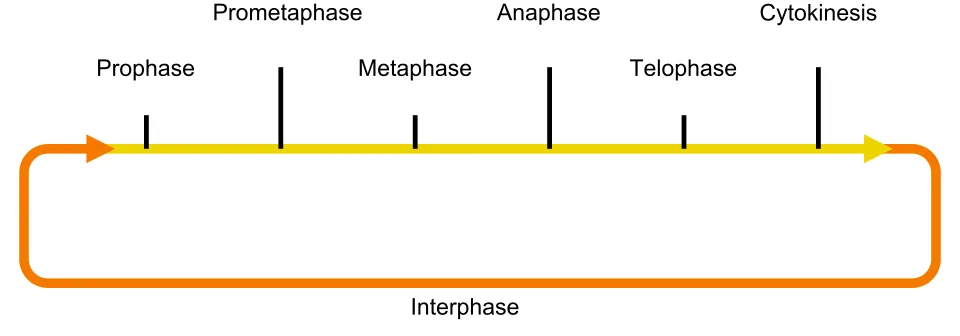
Image: Interphase and Mitosis.svg by Ph. Immel, public domain, via Wikimedia Commons.
The strip above is a timeline rather than a drawing of cells: it shows the order of interphase, prophase, prometaphase, metaphase, anaphase, telophase and cytokinesis on a single line, and the drawn figure above shows what happens to the chromosomes at each step.
| Question | The answer |
|---|---|
| In which phase of the cell cycle is DNA replicated? | the S phase of interphase |
| What happens during prophase? | the chromosomes condense, the nuclear envelope breaks down and the spindle forms |
| What happens during metaphase? | the chromosomes line up along the cell's equator |
| What happens during anaphase? | the sister chromatids are pulled apart and move to opposite poles |
| What happens during telophase? | the nuclear envelope re-forms around each set of chromosomes and the chromosomes decondense |
| What is cytokinesis? | the division of the cytoplasm, which separates the two daughter cells |
| How many cells does mitosis produce, and how do they compare with the parent? | two diploid cells, genetically identical to each other and to the parent |
| What moves the chromosomes during mitosis? | the spindle fibers, which attach at the centromere |
Meiosis: one cell into four different cells
Meiosis is the division that makes gametes. It runs the cell cycle twice with only one round of DNA replication, so one diploid cell produces four haploid cells, each with half the chromosome number of the parent. In a human that is 46 chromosomes in and 23 in each gamete — which is what makes 46 again when two gametes join.
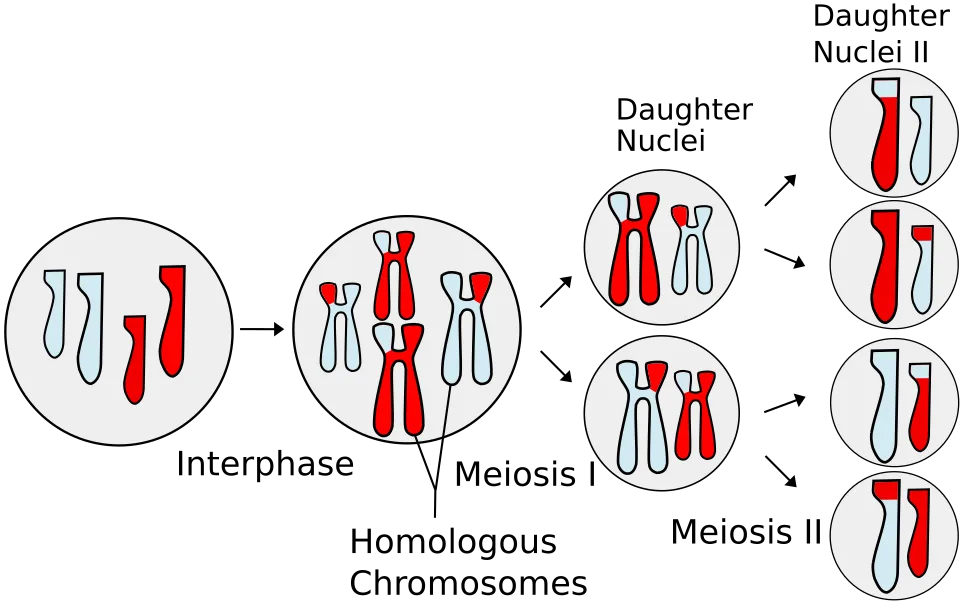
Image: Meiosis Overview.svg by National Institutes of Health (NCBI Science Primer), public domain, via Wikimedia Commons.
The two divisions do different jobs. Meiosis I is the reduction division: the homologous chromosomes — the matching pair, one from each parent — find each other and line up together, and then the pair is pulled apart, so each daughter cell gets one chromosome of each pair rather than both. Meiosis II separates the sister chromatids, exactly as mitosis does, and produces four cells.
Two events in meiosis I are where the variation comes from. Crossing over happens in prophase I, when non-sister chromatids of a homologous pair exchange segments, so the chromosomes that separate are not the ones that went in. Independent assortment happens at metaphase I, when each homologous pair lines up independently of the others, so which maternal and paternal chromosomes travel together is a matter of chance.
| Question | The answer |
|---|---|
| How many cells does meiosis produce, and what is their chromosome number? | four haploid cells, each with half the parent's chromosome number |
| In which division do homologous chromosomes separate? | meiosis I |
| In which division do sister chromatids separate? | meiosis II |
| What happens during crossing over? | non-sister chromatids of a homologous pair exchange segments during prophase I |
| What is independent assortment? | the random orientation of homologous pairs at metaphase I, so maternal and paternal chromosomes are distributed independently |
| What is a homologous pair? | two chromosomes of the same type, one inherited from each parent, carrying the same genes |
| How many chromosomes does a human gamete carry? | 23 |
| What is the result of fertilization? | a zygote with the diploid number, 46 in a human |
| Question | The answer |
|---|---|
| How many daughter cells does mitosis produce, and are they identical? | two, genetically identical to each other and to the parent |
| How many daughter cells does meiosis produce, and are they identical? | four, genetically different from each other and from the parent |
| Which division halves the chromosome number? | meiosis, through meiosis I |
| Where does crossing over happen? | in prophase I of meiosis, and nowhere in mitosis |
| What is mitosis for? | growth, repair and the replacement of cells |
| What is meiosis for? | producing gametes, and creating genetic variation |
Mendelian genetics: alleles and Punnett squares
A gene is a section of DNA that carries the instructions for a trait; an allele is one version of that gene. A cell carries two alleles for each gene, one on each chromosome of a homologous pair. If the two alleles are the same the organism is homozygous; if they differ it is heterozygous. The alleles an organism carries are its genotype; the trait you can see is its phenotype.
A dominant allele is expressed when one copy is present; a recessive allele is expressed only when both copies are recessive. That is Mendel's law of segregation: the two alleles of a gene separate when gametes form, so each gamete carries one.
A Punnett square is the bookkeeping. Write the possible gametes of one parent across the top and the other parent's down the side, then fill each box with one allele from each — one from the column, one from the row.
The square gives both ratios. Counting the four boxes gives the genotype ratio 1 BB : 2 Bb : 1 bb,
and grouping by what is visible gives the phenotype ratio 3 dominant : 1 recessive, because BB and
Bb look the same. The cross Bb × Bb is one monohybrid cross — one gene, two alleles.
| Question | The answer |
|---|---|
| What is the difference between a genotype and a phenotype? | the genotype is the alleles an organism carries; the phenotype is the trait that is expressed |
| What does homozygous mean? | both alleles for a gene are the same |
| What does heterozygous mean? | the two alleles for a gene are different |
| What is a dominant allele? | an allele that is expressed when at least one copy is present |
| What is a recessive allele? | an allele expressed only when both copies are recessive |
| What does Mendel's law of segregation state? | the two alleles of a gene separate when gametes form, so each gamete carries one |
What genotype ratio does Bb × Bb give? |
1 BB : 2 Bb : 1 bb |
What phenotype ratio does Bb × Bb give? |
3 with the dominant trait to 1 with the recessive |
| What is a testcross? | a cross with a homozygous recessive individual, used to reveal whether a dominant-looking parent is homozygous or heterozygous |
| What is incomplete dominance? | the heterozygote shows a blended phenotype between the two homozygotes |
| What is codominance? | both alleles are expressed fully, as in blood type AB |
| Why are X-linked recessive conditions more common in males? | a male has one X chromosome, so one recessive allele on it has no matching allele to mask it |
Classification and microorganisms
Classification is a filing system: it is about rank and about which group a thing belongs to. The ranks run from the broadest to the narrowest: domain, kingdom, phylum, class, order, family, genus, species.
| Question | The answer |
|---|---|
| What are the three domains? | Bacteria, Archaea and Eukarya |
| Which domain contains the plants, animals, fungi and protists? | Eukarya |
| Which kingdoms are usually recognized within Eukarya? | Protista, Fungi, Plantae and Animalia |
| What is binomial nomenclature? | the two-part scientific name of a species: the genus, capitalized, followed by the species name, both italicized |
| Which rank is written first in a scientific name? | the genus |
| What are the three bacterial shapes? | cocci (spheres), bacilli (rods) and spirilla (spirals) |
| What is a virus made of? | a protein coat, the capsid, around a nucleic acid — DNA or RNA — and sometimes a lipid envelope |
| Why is a virus not classified as a cell? | it has no cytoplasm, no organelles and no metabolism of its own; it reproduces only inside a host cell |
| Which group includes yeasts and molds? | the fungi, which are eukaryotic and have cell walls of chitin |
| Which group includes single-celled, motile, animal-like organisms? | the protozoa, in the kingdom Protista |
| Which group includes the photosynthetic single-celled organisms other than bacteria? | the algae, in the kingdom Protista |
Three practical consequences follow. Bacteria are prokaryotes, so their chromosome is a single circular molecule and they have no nucleus; they reproduce by binary fission, not by mitosis. Fungi are eukaryotes and are decomposers, absorbing nutrients from their surroundings rather than ingesting them. Viruses sit outside the cell theory — they are not cells, they do not grow or divide on their own, and they are described by the cell they infect.
The scientific method, and the parts of an experiment
The scientific method is a loop rather than a ladder: observe, ask a question, propose a hypothesis, predict what would follow if it were true, test it in a controlled experiment, analyze the result, and then keep, revise or discard the hypothesis. The last step is the one that matters most — a result that contradicts the prediction is information, not failure.
A hypothesis is a testable, falsifiable statement: if the sanitizer is present, then fewer colonies will grow. It is not a question, and it is not a guess that nothing could ever disprove.
| Part of the experiment | What it is | In a hand-sanitizer trial |
|---|---|---|
| independent variable | the one thing the experimenter changes on purpose | the sanitizer concentration: 0%, 50%, 100% |
| dependent variable | what is measured, and what changes because of the independent variable | the number of colonies on each plate |
| control group | the group that receives no treatment, or the standard treatment — the compare and contrast group | the 0% plate |
| constants | everything else held the same in every group | medium, volume, temperature, incubation time |
| experimental group | the group that receives the treatment | the 50% and 100% plates |
Worked example. A student swabs three agar plates with the same broth culture. Plate A receives 0 mL of sanitizer, plate B 0.5 mL and plate C 1.0 mL. All three are incubated at 37 °C for 24 hours, and the colonies are counted.
- The independent variable is the volume of sanitizer, because that is what the student chose to differ.
- The dependent variable is the colony count, because that is the outcome measured.
- The 0 mL plate is the control: it shows how much growth happens with nothing added, which is the only way to know whether a smaller count means anything.
- Temperature, medium and time are constants. If plate C were also incubated for 48 hours, the count would no longer measure the sanitizer.
Two vocabulary points deserve separate notice. Correlation is not causation: two things that change together may share a third cause, or one may cause the other, and only a controlled comparison separates them. And a scientific theory is not a hunch — it is an explanation supported by a body of evidence and still open to test, which is the opposite of the everyday use of the word.
Bacteria, and what a Gram stain tells you
A bacterium is a prokaryote: one circular chromosome, no nucleus, no membrane-bound organelles, ribosomes that differ from a eukaryote's, and a cell wall. Most bacteria divide by binary fission, which is not mitosis — there is no spindle and no chromosome condensation to see. Their three shapes are cocci (spheres), bacilli (rods) and spirilla (spirals), and they are also named by how they group: streptococci in chains, staphylococci in clusters.
The Gram stain sorts bacteria by what their cell wall does to a dye. It is a differential stain: four reagents, used in order, and the thickness of the wall decides the result.
| Step | Reagent | What it does |
|---|---|---|
| 1 | crystal violet | stains every cell purple |
| 2 | iodine | a mordant: forms a large crystal-violet–iodine complex inside the cell |
| 3 | alcohol or acetone | the decolorizer: washes the complex out of a thin wall, not out of a thick one |
| 4 | safranin | a counterstain: colors the now-colorless cells pink or red |
Gram-positive cells have a thick peptidoglycan wall that holds the complex, so they stay purple. Gram-negative cells have a thin peptidoglycan layer under an outer membrane; the alcohol removes the complex, and the safranin turns them pink or red.
Worked example. A sputum smear shows pink rod-shaped cells after a Gram stain. What can be said about the organism?
- Pink means the crystal violet was washed out and the safranin was taken up, so the wall is thin: the organism is Gram-negative.
- Rod-shaped means bacillus (plural bacilli).
- The answer is therefore Gram-negative bacilli — a description of the wall and the shape, not a species. A Gram stain narrows the field; naming the organism needs a culture and further tests.
The result is clinically useful because the two wall types respond differently to antibiotics: the outer membrane of a Gram-negative cell keeps many drugs out, which is one reason those infections are harder to treat. Note also that Gram is capitalized — it is named for Hans Christian Gram — while gram is a unit of mass.
The chain of infection, and the five routes
An infection is not one event but a sequence of six links, and it takes all six. Break any one, and the infection does not happen.
| Link | What it is | What breaks it |
|---|---|---|
| infectious agent | the organism: bacterium, virus, fungus, parasite, prion | sterilization, disinfection, antibiotics |
| reservoir | where it lives and multiplies: a person, water, soil, equipment | cleaning, vector control, covering a wound |
| portal of exit | how it leaves: respiratory droplets, blood, urine, feces, a draining wound | containment, dressings, respiratory hygiene |
| mode of transmission | how it travels to the next host | hand hygiene, PPE, isolation, air handling |
| portal of entry | how it enters: the respiratory tract, a break in skin, a catheter, a mucous membrane | aseptic technique, intact dressings, safe devices |
| susceptible host | someone who can be infected: very young, very old, immunocompromised, unvaccinated, postoperative | vaccination, nutrition, treating underlying disease |
The US Centers for Disease Control and Prevention groups modes of transmission into five: contact, droplet, airborne, common vehicle, and vector-borne. Contact is the mode with two kinds — direct, from body surface to body surface, and indirect, through an object or a hand that carries the organism between people.
| Mode | How it travels | Example | What interrupts it |
|---|---|---|---|
| contact — direct | body surface to body surface | a wound touched during a dressing, a handshake | hand hygiene, gloves |
| contact — indirect | through a contaminated object (a fomite) or hands that carry an organism between patients | a shared stethoscope or bed rail; a nurse's uncleaned hands | cleaning equipment and hands between patients |
| droplet | large respiratory droplets from coughing or sneezing, over a short distance | influenza, pertussis | a mask, spatial separation |
| airborne | tiny particles that stay suspended and travel on air currents | tuberculosis, measles | an N95 respirator, a negative-pressure room |
| common vehicle | food, water, blood or a medication that carries the organism to many people at once | a contaminated saline bag shared by a ward | safe water, sterile supplies, one dose per vial |
| vector-borne | carried by an insect or another animal | malaria by mosquito, Lyme disease by tick | repellent, nets, vector control |
Hands are the classic indirect route: the organism does not grow on the hand, the hand carries it to the next patient, and hand hygiene between patients removes the carrier.
Worked example. A nurse moves from one patient's infected wound to the next bed without cleaning their hands. Which link did the nurse become?
- The organism left the first patient through a portal of exit — the draining wound.
- It traveled on the nurse's hands, which is indirect contact: a carrier takes the organism from one body to the next.
- The next patient's surgical incision is the portal of entry.
- The nurse was the mode of transmission. Hand hygiene between patients breaks that link, and it is the step that interrupts the chain.
The immune response in outline
Immunity has two layers, and which layer is doing the work decides how fast the response comes.
Innate immunity is present from birth, acts within minutes, and does not improve with repeat exposure. Its first line is the barrier: skin, mucous membranes, cilia, stomach acid, tears. Its second line is the response once something gets through — inflammation (redness, heat, swelling, pain), fever, phagocytes that engulf invaders, natural killer cells, and a set of plasma proteins including complement.
Adaptive immunity is specific and it remembers. It takes days the first time and hours the second time, because it keeps memory cells. It has two arms: B cells become plasma cells and release antibodies into the blood and lymph (humoral immunity), while T cells work cell to cell (cell-mediated immunity) — helper T cells coordinate the response, and cytotoxic T cells destroy infected cells.
An antigen is the molecule the immune system recognizes. An antibody is the protein a B-cell line makes against it. The two are not opposites and not interchangeable: the antigen is the target, the antibody is the weapon.
Worked example. A child has chickenpox, recovers, and is later exposed again without becoming ill. Why?
- The first infection produced memory B and T cells specific to that virus.
- On the second exposure those cells are already present, so the secondary response is faster and stronger than the first.
- The result is immunity — the same principle a vaccine uses, presenting the antigen without the disease so the memory cells can form safely.
Water: cohesion, adhesion and specific heat
Water is the solvent life runs in, and its behavior comes from one fact: it is polar. The oxygen end carries a slight negative charge and the hydrogen ends a slight positive charge, so one molecule is attracted to the next — a hydrogen bond.
- Cohesion is water sticking to water. It holds a column of water together in a plant's xylem and it produces surface tension, which is why an insect can walk on a pond.
- Adhesion is water sticking to other polar surfaces. With cohesion it produces capillary action: water climbing a narrow tube against gravity.
- High specific heat is the energy needed to raise one gram of water by one degree Celsius — about 4.18 joules, or one calorie. Water absorbs a great deal of heat for a small rise in temperature, which is why cells and bodies resist a sudden change.
- High heat of vaporization is the energy needed to turn liquid water into vapor. Evaporating sweat takes that energy from the skin, which is why sweating cools a body.
Worked example. Why does sweating cool a person, and why does a lake stay cooler than the sand beside it on a hot afternoon?
- Sweat cooling is evaporation: every gram of water that leaves the skin carries its heat of vaporization away with it. The property doing the work is the high heat of vaporization.
- The lake stays cooler because its specific heat is high — a large amount of sunlight produces only a small rise in temperature, while sand, with a much lower specific heat, heats quickly.
- The two properties are related but not the same, so read which one the sentence describes before choosing.
The traps, collected
The wrong answer on this topic is almost always a term used one level too wide, or a process with its input and output swapped.
| Question | The answer |
|---|---|
| What separates mitosis from meiosis? | mitosis gives two identical diploid cells; meiosis gives four haploid cells that differ from each other |
| What separates a genotype from a phenotype? | the genotype is the pair of alleles; the phenotype is the trait that shows |
| What separates diffusion from osmosis? | diffusion moves any solute down its gradient; osmosis moves water across a membrane |
| What separates facilitated diffusion from active transport? | both use a protein, but active transport moves against the gradient and spends ATP |
| What separates a hypertonic from a hypotonic solution? | hypertonic has more solute than the cell, so the cell loses water; hypotonic has less, so the cell gains it |
| What separates transcription from translation? | transcription copies DNA into mRNA; translation builds a protein from mRNA |
| What separates DNA from RNA? | DNA is double-stranded with deoxyribose and thymine; RNA is single-stranded with ribose and uracil |
| What separates aerobic from anaerobic respiration? | aerobic uses oxygen and the electron transport chain; anaerobic stops at fermentation |
| What separates a prokaryote from a eukaryote? | the prokaryote has no nucleus and no membrane-bound organelles |
| What separates a codon from an anticodon? | the codon is three bases of mRNA; the anticodon is the three bases of tRNA that pair with it |
| What separates haploid from diploid? | haploid is one set of chromosomes; diploid is two sets, one from each parent |
| What separates a chloroplast from a mitochondrion? | the chloroplast captures energy in photosynthesis; the mitochondrion releases it in respiration |
| What separates crossing over from independent assortment? | crossing over exchanges segments within a homologous pair; independent assortment decides how whole pairs are distributed |
How to practice this
- Draw the process before you name its stages. Glycolysis, the Krebs cycle and the electron transport chain are three places; mitosis is four phases plus interphase. A drawing that puts each name in the right place is a map you can reason from.
- Say the input and the output together. "Glycolysis: glucose in, two pyruvate, two ATP and two NADH out" is a fact you can check; the stage name alone is not.
- Work a Punnett square every time, even when the ratio is familiar. The four boxes make the ratio visible, and a question can ask for the genotype ratio instead of the phenotype ratio.
- Keep the four counts separate. A human body cell has 46 chromosomes; a gamete has 23; a cell after mitosis has 46; a cell after meiosis has 23. Most errors on this topic are one of those numbers used in the wrong place.
- Check whether the question is about a solution or a cell. "The solution is hypertonic" and "the cell is in a hypertonic solution" describe the same situation, and neither says the cell is hypertonic.
Where to go next
- The subject's own page — Biology lists what is published for this subject, including its guide and its practice set as they land.
- The body built from these cells — Anatomy and Physiology: tissues, organs and systems, which is the level above this one.
- The measurements a cell is described with — Measurement and Conversion: the units a lab-style question uses.
Sources. The genetics definitions on this page follow the National Human Genome Research
Institute's Talking Glossary of Genomic and Genetic Terms (genome.gov/genetics-glossary), US
federal government material that is not subject to copyright in the United States. Cell and
organelle descriptions follow the US National Cancer Institute's SEER Training Modules
(training.seer.cancer.gov), and process-level descriptions follow MedlinePlus
(medlineplus.gov), the US National Library of Medicine's consumer health service. Modes of
transmission follow the US Centers for Disease Control and Prevention (cdc.gov), which groups
them as contact, droplet, airborne, common vehicle and vector-borne, with direct and indirect
as the two kinds of contact; the chain of infection and the Gram stain follow the same
guidance. The standard teaching values are stated as such: 46 chromosomes in a human body cell
and 23 in a gamete, 64 codons specifying 20 amino acids, and about 30 to 32 ATP from the
aerobic respiration of one glucose molecule. The publisher's own account of the areas the exam
covers is quoted from its HESI A2 page. Each picture on this page carries its source, author
and license in the credit beneath it. Accessed 2026-10-25.
HESI A2 is a trademark of Elsevier Inc. Elk Ridge Academy is an independent study resource and is not affiliated with, endorsed by, or sponsored by Elsevier Inc. Exam names are used descriptively only.
Source: NHGRI Talking Glossary of Genomic and Genetic Terms (National Human Genome Research Institute) for the genetics definitions; NCI SEER Training Modules on the cell (US National Cancer Institute) for cell and organelle structure; MedlinePlus (US National Library of Medicine) for process-level descriptions; the CDC's Principles of Epidemiology in Public Health Practice (third edition, lesson 1, section 10) for the chain of infection; the USGS Water Science School for cohesion, adhesion and specific heat. All are US federal government material, not subject to copyright in the United States. Every picture carries its own author and license in the credit beneath it (NHGRI, NCI SEER, MedlinePlus and the USGS Water Science School accessed 2026-10-28; CDC Principles of Epidemiology in Public Health Practice, third edition, accessed 2026-10-28; the Elsevier HESI A2 page accessed 2026-10-23)